
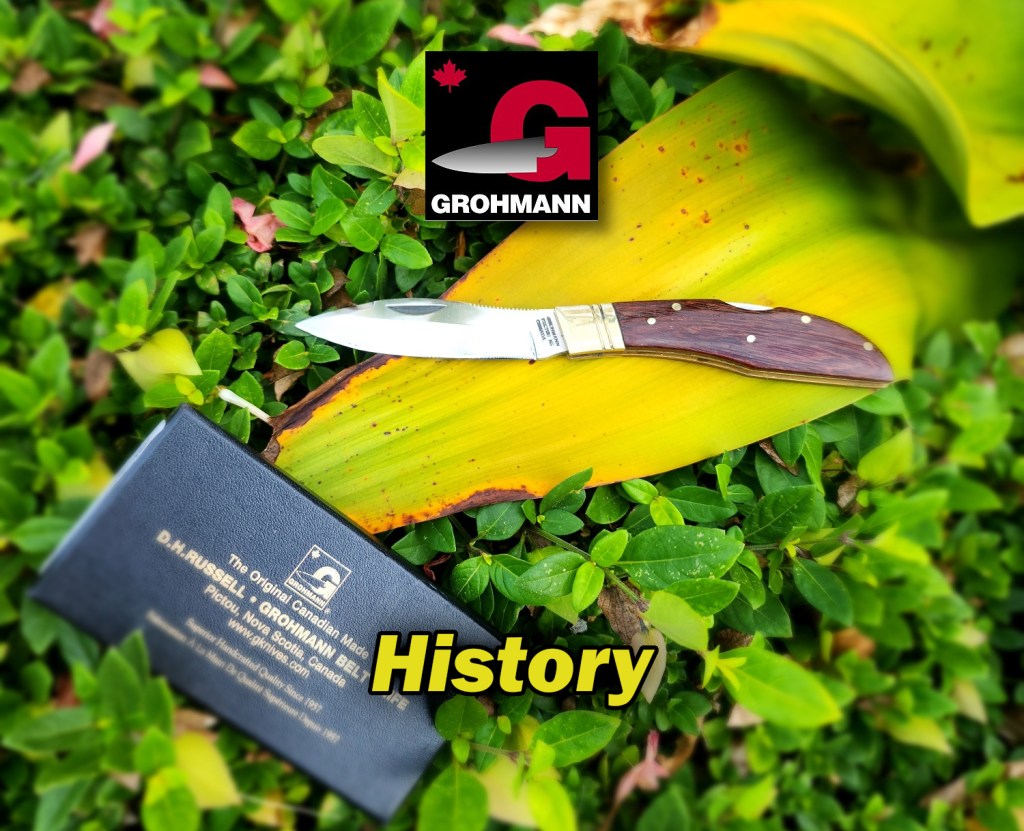
Few knife makers carry a story as rich and enduring as Grohmann Knives—a brand that blends European craftsmanship, immigrant perseverance, and distinctly Canadian design. From its origins in pre-war Europe to its modern home in Nova Scotia, the company’s history is as sharp and resilient as the blades it produces.
Origins in Europe
The story of Grohmann Knives begins long before the company itself existed. Its founder, Rudolph Grohmann, was a skilled knife maker in the Sudetenland region of what was then Czechoslovakia. Before World War II, Grohmann worked as a production manager in a knife factory, honing his craft in a region known for fine cutlery.
Even during those years, there were hints that Grohmann’s future lay elsewhere. A Canadian buyer who regularly visited the factory encouraged him to immigrate to Canada and start a new venture. Grohmann declined at first—but history would soon change his course.
Immigration and a New Beginning (1949)
After World War II, political instability in Eastern Europe pushed Grohmann to reconsider. In 1949, he emigrated to Canada with his family, settling in Pictou, Nova Scotia, at the invitation of a government-supported initiative called Pictou Cutlery.
The venture, however, was short-lived. Within a few years, the factory shut down, leaving Grohmann without a stable workplace. Rather than abandon his trade, he did something that would define the company’s legacy: he built a small workshop in his garage and continued making knives by hand.
The Birth of a Canadian Knife
Grohmann’s big breakthrough came through collaboration. He met Deane H. Russell, a Canadian outdoorsman and government official who believed Canada needed its own signature outdoor knife design.
Together, they conducted extensive research, consulting hunters, trappers, and woodsmen across the country. The result was the D.H. Russell “Original Design” Belt Knife (No. 1)—a blade specifically tailored to Canadian outdoor needs.
Introduced in 1957, the knife stood out for its distinctive shape and ergonomic handle. It quickly gained recognition and would go on to become one of the most iconic knife designs in Canada, even inspiring numerous imitations.
Founding of Grohmann Knives Ltd. (1961)
With the success of the Russell design, the family formalized their operation. In 1961, Grohmann Knives Limited was officially established as a family-run business.
Leadership soon passed to Grohmann’s daughter, Berta Grohmann Babinec, and her husband, Michael Babinec Sr. Over time, the business remained firmly in family hands, with multiple generations contributing to its growth.
This continuity helped preserve the company’s core philosophy: craftsmanship over mass production.
Growth and Recognition
Throughout the 1960s and beyond, Grohmann expanded its product line. Building on the success of the No. 1 knife, the company introduced additional models such as:
- The #2 Trout & Bird knife
- The #3 Boat knife
- The #4 Survival knife
These designs gained popularity among outdoors enthusiasts and even saw use in military contexts. Over time, Grohmann knives earned awards and international recognition, becoming a symbol of Canadian outdoor culture.
Despite this growth, the company remained small by design. Even today, production involves dozens of steps—sometimes over 50—to create a single knife, emphasizing quality and durability over scale.
A Family Legacy in Modern Times
Grohmann Knives continues to operate out of Pictou, Nova Scotia, more than half a century after its founding. The company is still family-owned, now run by Michael Babinec Jr. and his daughter Michelle, representing the third generation of leadership.
The product line has expanded beyond outdoor knives to include kitchen cutlery and specialty blades, all while maintaining the same dedication to craftsmanship.
Enduring Influence
What makes Grohmann Knives remarkable isn’t just its longevity—it’s the way it has preserved its identity. In an industry increasingly dominated by mass production, Grohmann has stayed true to its roots:
- Handmade craftsmanship
- Functional, field-tested design
- Strong ties to Canadian outdoor culture
The original Belt Knife remains a benchmark in ergonomic design, and the company’s story continues to resonate with those who value tradition and quality.
Conclusion
The history of Grohmann Knives is more than a business timeline—it’s a story of resilience, adaptation, and craftsmanship passed through generations. From a small garage workshop in Nova Scotia to a globally recognized brand, Grohmann has carved out a legacy that reflects both its European origins and its Canadian identity.
In every blade, there’s a piece of that journey—shaped by history, refined by experience, and built to last.
 Knife History
Leave a comment