
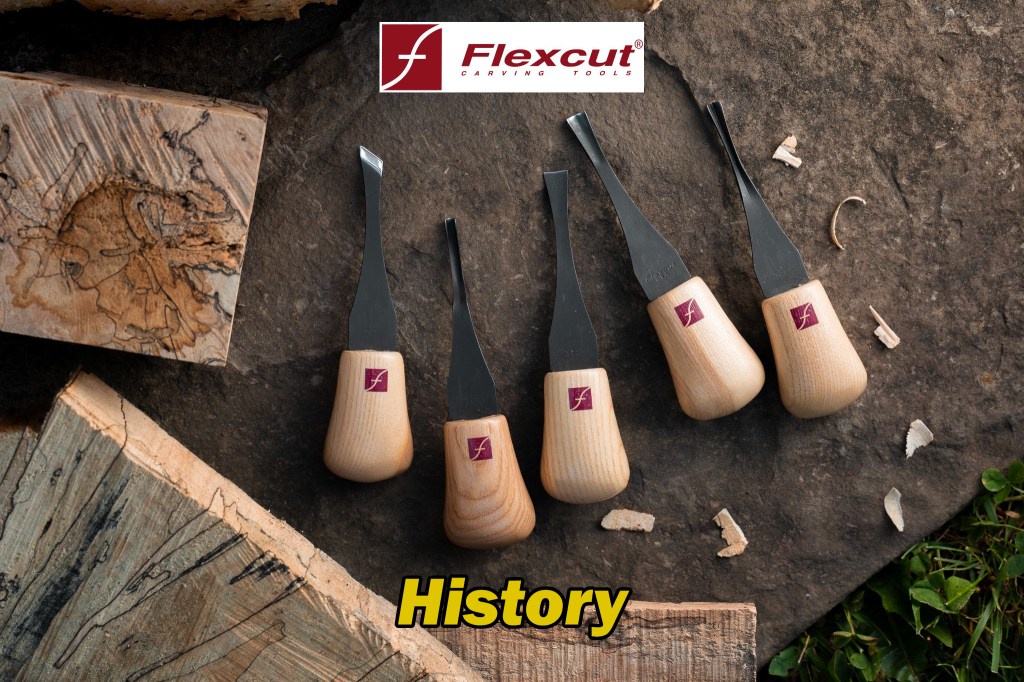
Flexcut is a modern American tool company best known for its woodcarving knives and palm tools. While carving itself dates back thousands of years, Flexcut’s contribution to the craft lies in refining ergonomics, improving blade flexibility, and making carving more accessible to hobbyists and professionals alike.
Unlike centuries-old European blade houses, Flexcut represents a late 20th-century innovation story—one built on problem-solving rather than tradition alone.
Origins in Pennsylvania
Flexcut was founded in 1992 in Erie, Pennsylvania. The company emerged from a desire to improve traditional carving tools, particularly in terms of comfort and blade control.
Woodcarving tools historically required frequent sharpening and often featured rigid blades that limited subtle cutting movements. The founder of Flexcut sought to address these issues by developing tools that combined high-quality steel with improved flexibility and ergonomic handles.
From its beginnings, the company focused specifically on carving tools rather than general-purpose knives.
The Innovation of Flexible Blades
Flexcut’s defining innovation was its flexible blade design. Unlike many traditional carving knives with stiff profiles, Flexcut blades were engineered to bend slightly under pressure.
This flexibility allowed carvers to maintain better control, especially when making long slicing cuts. The blade’s movement helped reduce digging and chatter, producing smoother surfaces in wood.
For many users, this innovation made carving less physically demanding and more precise.
It also gave the brand its name.
Ergonomics and Accessibility
Another key development in Flexcut’s history was its focus on ergonomic handle design. Traditional carving tools often used straight wooden handles that could become uncomfortable during extended use.
Flexcut introduced contoured handles designed to fit naturally in the hand. This reduced fatigue and made carving more approachable for beginners.
By improving comfort and control, the company expanded the potential audience for woodcarving—from professional artisans to hobbyists and newcomers.
Growth During the Hobby Craft Revival
The 1990s and early 2000s saw renewed interest in traditional crafts, including woodworking and carving. As more people explored handcraft hobbies, demand grew for tools that were both high quality and user-friendly.
Flexcut benefited from this trend. Its tools became popular among whittlers, relief carvers, and instructional carving programs.
The brand positioned itself as a reliable American manufacturer offering tools that balanced performance and approachability.
Expansion of Product Lines
Over time, Flexcut expanded beyond its original carving knives to include palm tools, gouges, chisels, and specialty carving sets.
Palm tools—short-handled tools designed for one-handed use—became particularly popular. These tools allowed for close, controlled carving movements and appealed to those working on smaller projects.
Flexcut also introduced interchangeable blade systems, allowing users to swap carving profiles within a single handle system. This innovation added versatility without requiring large tool collections.
Steel and Heat Treatment
Flexcut tools are made from high-carbon steel selected for edge retention and ease of sharpening. Carving tools require razor-sharp edges to slice cleanly through wood fibers rather than tear them.
The company developed proprietary heat treatment processes to balance hardness with durability. Because carving involves controlled slicing rather than impact, maintaining a fine edge is critical.
This focus on steel performance reinforced the brand’s credibility among serious carvers.
Commitment to American Manufacturing
Like several respected tool brands, Flexcut has maintained domestic manufacturing in Pennsylvania. In an era when many tool companies outsourced production, Flexcut emphasized its American-made identity.
For customers interested in craftsmanship and quality control, this commitment became part of the brand’s appeal.
The company’s size allowed it to remain focused on niche specialization rather than mass-market expansion.
Flexcut Today
Today, Flexcut remains one of the most recognized names in modern woodcarving tools. Its knives and palm tools are widely used by hobbyists, instructors, and professional artisans.
The company continues to refine blade shapes and handle designs while maintaining its core identity centered on flexibility and ergonomic control.
In a world increasingly dominated by power tools, Flexcut stands firmly in the hand-tool tradition.
A Modern Chapter in an Ancient Craft
The history of Flexcut demonstrates how innovation can enhance traditional crafts without replacing them. By rethinking blade flexibility and handle ergonomics, the company helped make woodcarving more accessible and comfortable for modern users.
Founded in 1992, Flexcut did not inherit centuries of knife-making history—but it contributed meaningful improvements to the carving experience.
Its legacy lies not in ornate decoration or historic lineage, but in practical refinements that allowed artisans to carve with greater control, comfort, and confidence.
 Knife History
Leave a comment