
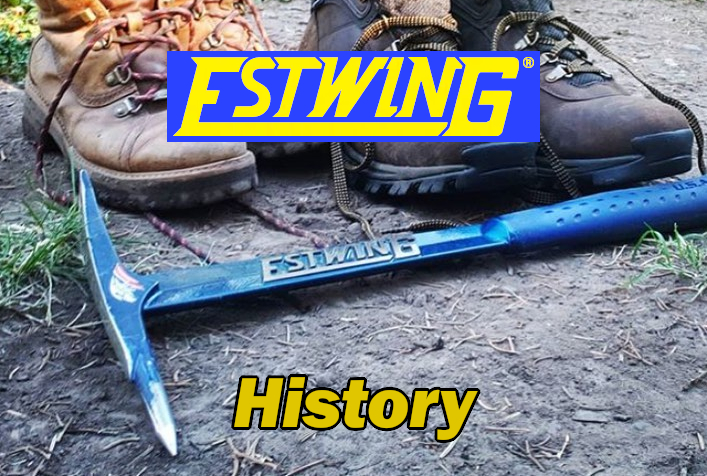
Estwing is one of the most recognizable names in American striking tools. Best known for its one-piece steel hammers and axes, the company built its reputation on durability, simplicity, and domestic manufacturing. While not a knife brand in the traditional sense, Estwing’s history overlaps heavily with outdoor tools, construction trades, and American industrial development.
The story of Estwing is one of consistency—refining a core design philosophy rather than chasing trends.
Founding in Rockford, Illinois
Estwing was founded in 1923 in Rockford, Illinois, by Ernest O. Estwing. At the time, America was in a period of rapid industrial expansion. Construction, manufacturing, and infrastructure projects demanded reliable hand tools.
Ernest Estwing introduced a distinctive concept: forging tools from a single piece of solid steel. Unlike traditional hammers that used wooden handles attached to separate heads, Estwing’s design eliminated the weak point where handles could loosen or break.
This innovation became the defining feature of the company.
The One-Piece Forged Construction
Estwing’s signature manufacturing method involves forging the head and handle as one continuous piece of American steel. This design dramatically increases durability and strength while reducing maintenance.
The approach was particularly valuable for construction workers, mechanics, geologists, and tradesmen who relied on tools daily. Fewer moving parts meant fewer failures.
The company later added shock-reduction grips—bonded leather stacks or rubberized handles—to improve comfort without sacrificing structural integrity.
This balance of strength and usability helped solidify the brand’s reputation.
Growth Through the Trades
Throughout the mid-20th century, Estwing tools became common on construction sites and in workshops across the United States. Carpenters, framers, and industrial workers trusted the brand for its reliability.
Geological hammers became another specialty product. Field geologists valued the durability of one-piece steel construction when working in rugged terrain.
By focusing on professionals first, Estwing built a brand image tied to hard use and dependability.
Expansion Into Outdoor Tools
As outdoor recreation grew in popularity in the latter half of the 20th century, Estwing expanded its lineup to include axes, hatchets, and specialty striking tools suited for camping and wood processing.
The same one-piece forged steel concept carried into these products. Estwing hatchets and campers’ axes became known for toughness and long service life.
Rather than competing on lightweight materials or modern composites, the company stayed committed to forged steel durability.
This consistency reinforced brand identity.
Commitment to American Manufacturing
A defining element of Estwing’s history is its continued domestic production. The company has maintained manufacturing operations in Rockford, Illinois, for over a century.
In an era when many tool companies shifted overseas, Estwing’s decision to keep production in the United States became part of its marketing and identity.
For many customers, the “Made in USA” mark represents quality control, heritage, and trust.
Design Philosophy and Market Position
Estwing’s design philosophy has remained straightforward: build tools that last. The brand has not heavily pursued modular systems, replaceable handle technology, or radical aesthetic changes.
Instead, its product line evolves gradually—refining grip materials, balance, and finish while preserving the forged steel core.
This disciplined approach appeals to professionals and outdoor users who value reliability over novelty.
Estwing in the Modern Era
Today, Estwing continues to produce hammers, axes, knives, specialty striking tools, and geological equipment. The company occupies a strong position in both professional and recreational markets.
While competitors experiment with fiberglass and composite handle systems, Estwing remains closely associated with steel construction and traditional durability.
Its tools are often seen as long-term investments rather than disposable equipment.
A Century of Forged Reliability
The history of Estwing is defined by a single foundational decision: forging tools from one piece of steel. That engineering choice shaped a century of product development and brand identity.
Founded in 1923, the company grew alongside American industry, earning trust in workshops, construction sites, and wilderness camps alike.
In a tool market filled with constant redesign and innovation cycles, Estwing’s enduring presence is built on a simpler promise—strength, reliability, and consistency forged into steel.
 Knife History
Leave a comment