
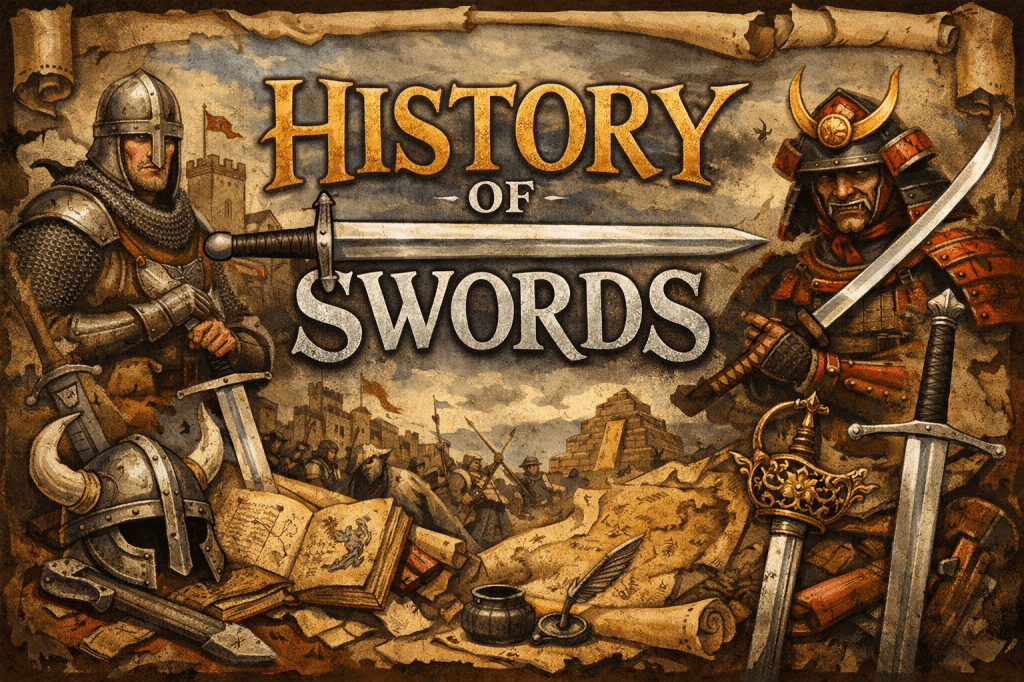
Few weapons in human history carry the same weight—both literal and symbolic—as the sword. Across civilizations, eras, and continents, swords have served as tools of war, markers of status, symbols of justice, and objects of myth. More than simple weapons, swords reflect the technological progress, cultural values, and martial traditions of the societies that forged and wielded them. The history of the sword is, in many ways, the history of organized warfare and human craftsmanship itself.
Early Origins: The Birth of the Sword
The earliest swords emerged during the Bronze Age, roughly around 1600 BCE. Before this period, edged weapons were generally short daggers or knives made of stone, copper, or early bronze. These tools lacked the length and balance necessary to be considered true swords. Advances in metalworking, particularly the ability to cast longer bronze blades, made it possible to create weapons that extended beyond simple stabbing implements.
Bronze swords were typically leaf-shaped, with a central ridge to add strength and prevent bending. These early swords were effective cutting and thrusting weapons but remained limited by the material itself. Bronze, while workable, was relatively soft compared to later metals and prone to deformation. As a result, these swords required frequent maintenance and careful handling.
Despite their limitations, bronze swords represented a significant leap in warfare. They allowed soldiers to fight at slightly greater distances and offered more versatility in combat. Cultures such as the Mycenaeans, Hittites, and Egyptians developed distinctive sword designs, each reflecting local combat styles and metallurgical knowledge.
The Iron Age Revolution
The transition from bronze to iron fundamentally changed sword design and effectiveness. Beginning around 1200 BCE, iron gradually replaced bronze as the primary material for weapons. Although early iron was not always superior to bronze, improvements in smelting techniques eventually produced blades that were stronger, more durable, and easier to repair.
Iron swords could be made longer without sacrificing strength, leading to new forms optimized for slashing, thrusting, or both. The Celtic tribes of Europe became renowned swordmakers during this era, producing long, flexible blades that influenced Roman weapon design. These swords often featured pattern welding, an early technique that layered different types of iron and steel to improve performance.
As iron technology spread, swords became more accessible. No longer reserved only for elites, swords began appearing more frequently among professional soldiers. This shift played a key role in the rise of organized armies and standardized military equipment.
Classical Antiquity: Swords of Empires
During classical antiquity, swords became central to the military systems of powerful empires. The Roman gladius is one of the most famous examples. Short, wide, and optimized for thrusting, the gladius was designed to work in tight formations. Roman legionaries used large shields to create openings, delivering devastating stabs rather than wide cuts.
As Roman tactics evolved, so did their swords. The later spatha, a longer blade originally associated with cavalry, eventually replaced the gladius among infantry as battlefield formations became more fluid. This longer sword would go on to influence medieval European sword design.
Elsewhere, Greek hoplites favored shorter swords as secondary weapons, while Persian and Near Eastern cultures developed curved blades better suited for slashing from horseback. In China, bronze swords remained in use longer than in Europe, eventually transitioning to steel blades during the Warring States period. These swords were often straight, double-edged, and paired with sophisticated metallurgical techniques.
Across the ancient world, swords were not just weapons but symbols of authority. Rulers, generals, and nobility carried ornate blades that reflected their status, reinforcing the sword’s role as both a practical and cultural object.
The Middle Ages: Craftsmanship and Chivalry
The medieval period marked a golden age of sword development in Europe. Advances in steelmaking allowed for stronger, more refined blades that balanced cutting power with durability. Early medieval swords were typically broad, double-edged, and designed for use against lightly armored opponents.
As armor evolved from chainmail to plate, sword designs adapted accordingly. Blades became narrower and more pointed, emphasizing thrusting attacks capable of exploiting gaps in armor. The rise of specialized sword types reflected the changing realities of medieval combat, with weapons tailored for specific roles on the battlefield.
During this era, swords took on powerful symbolic meanings. Knights swore oaths on their swords, and religious iconography often depicted swords as instruments of divine justice. The act of knighting itself involved the ceremonial touch of a sword on the shoulders, reinforcing its association with honor and duty.
Swordsmiths achieved remarkable levels of craftsmanship, producing blades that were both functional and aesthetically striking. Inscriptions, decorative hilts, and carefully shaped pommels became common. While many swords were utilitarian tools of war, others were clearly intended as heirlooms or status symbols.
The Islamic World and Curved Blades
While European swords evolved primarily along straight-blade lines, many regions of the Islamic world favored curved designs. Curved swords excelled at slashing attacks, particularly from horseback, and became closely associated with cavalry warfare.
Blades such as the scimitar and shamshir were crafted from high-quality steel and prized for their cutting ability. Some of the finest swords of this period were made using crucible steel techniques, producing blades with exceptional strength and sharpness. These swords were often lighter and more flexible than their European counterparts, allowing for fluid, fast strikes.
The cultural significance of swords in the Islamic world mirrored that of Europe. Swords were celebrated in poetry, art, and legend, representing bravery, faith, and martial skill. Trade and warfare between East and West also led to cross-cultural influences, with techniques and designs spreading across borders.
East Asia: Precision and Philosophy
In East Asia, sword development followed a distinct path shaped by different philosophies of combat and craftsmanship. In China, straight double-edged swords coexisted with single-edged blades designed for chopping and slicing. Military treatises emphasized balance, control, and adaptability, which influenced sword design.
Japan’s sword tradition stands apart for its technical refinement and cultural depth. The Japanese sword evolved in response to changes in armor and fighting styles, eventually resulting in the curved, single-edged blades most people recognize today. These swords were designed for decisive cuts and were forged using complex folding techniques to balance hardness and flexibility.
Japanese swordsmiths elevated blade-making to an art form, with strict rituals governing the forging process. Each sword was considered unique, imbued with the spirit of its maker. Beyond the battlefield, swords held deep spiritual and social meaning, often associated with the warrior code and personal honor.
The Decline of the Battlefield Sword
The introduction of firearms marked the beginning of the sword’s decline as a primary battlefield weapon. As gunpowder weapons became more reliable and widespread, heavily armored combat gave way to ranged engagements. While swords remained useful as sidearms, their dominance on the battlefield faded.
During the Renaissance and early modern period, swords adapted to new roles. Civilian swordsmanship flourished, with lighter blades designed for dueling and personal defense. Rapiers, smallswords, and other slender designs emphasized speed and precision over brute force.
Military swords continued to exist, particularly among officers and cavalry, but their role was increasingly symbolic. By the 19th century, swords were largely ceremonial, carried to signify rank rather than for practical combat.
Swords in the Modern World
Although swords are no longer standard military weapons, their legacy endures. Ceremonial swords remain part of military traditions worldwide, and historical blades are preserved in museums and private collections. Martial arts schools continue to teach swordsmanship, preserving techniques passed down through generations.
Modern swordmakers blend traditional methods with contemporary materials, producing functional blades for collectors, practitioners, and enthusiasts. At the same time, swords have found a permanent place in popular culture, appearing in films, literature, and video games as symbols of heroism, power, and adventure.
The fascination with swords persists because they represent more than violence. They embody human ingenuity, artistry, and the timeless struggle between conflict and honor.
A Legacy Forged in Steel
The sword’s journey spans thousands of years, evolving alongside humanity itself. From crude bronze blades to masterfully forged steel weapons, swords reflect the technological progress and cultural values of the societies that wielded them. Though their role in warfare has faded, their influence remains strong.
Today, swords stand as reminders of an age when craftsmanship and combat were deeply intertwined. They continue to inspire respect, curiosity, and admiration, proving that even in a modern world, the legacy of the sword remains sharp.
 Knife History
Leave a comment