
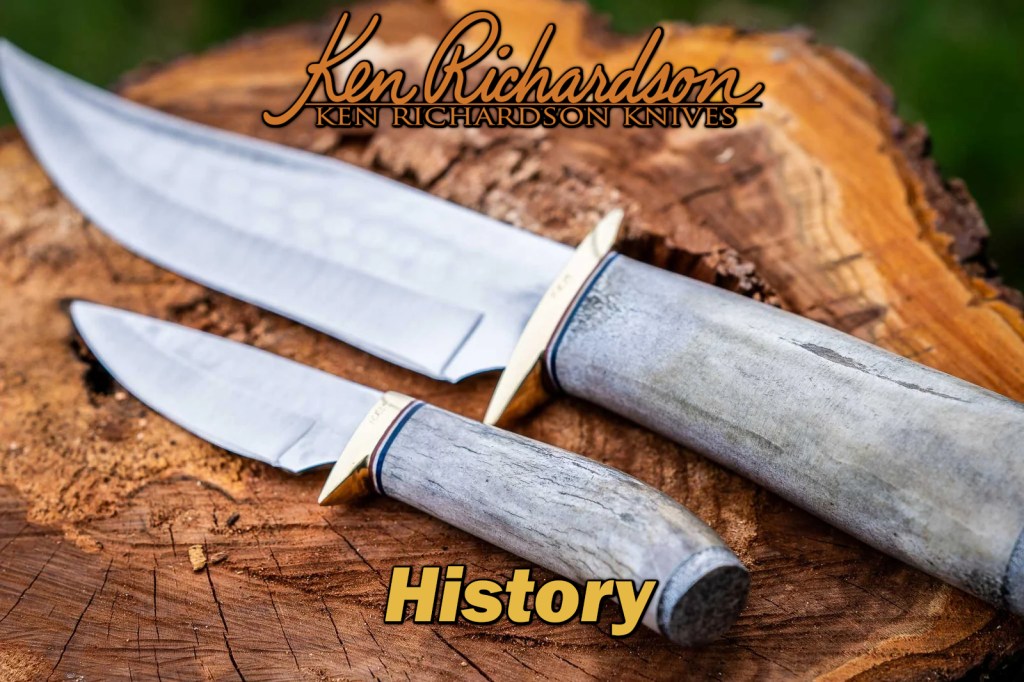
Ken Richardson is widely regarded as one of the most influential custom knifemakers of the late 20th century. Known for his exceptional forging skills, meticulous attention to detail, and deep respect for traditional blade-making techniques, Richardson helped define what modern custom knifemaking could be. His knives are not mass-produced tools, but carefully crafted works that reflect both functional excellence and artistic discipline.
The history of Ken Richardson knives is closely tied to the rise of the American custom knife movement, a period when individual makers began to gain recognition for their skill, originality, and dedication to craftsmanship. Richardson’s work stands out not because it followed trends, but because it consistently embodied technical mastery and a reverence for the forging process itself.
Early Life and Introduction to Bladesmithing
Ken Richardson’s path into knifemaking began long before he was widely known in collector circles. Like many accomplished bladesmiths, his early interest in metalwork grew from hands-on experience and curiosity rather than formal schooling. Richardson was drawn to forging and blacksmithing techniques that emphasized shaping steel through heat and hammer work rather than relying solely on stock removal.
This early focus on forging would become central to his identity as a maker. At a time when many knifemakers were adopting modern machining tools, Richardson embraced traditional methods that required patience, precision, and deep understanding of steel behavior.
His early knives reflected a commitment to learning the fundamentals before pursuing complexity or recognition.
The Rise of the Custom Knife Movement
Ken Richardson’s career developed alongside the broader emergence of the American custom knife movement in the 1970s and 1980s. During this period, individual makers began to gain national attention through knife shows, collector networks, and specialty publications. Custom knives were increasingly viewed as both functional tools and collectible art objects.
Richardson’s work fit naturally into this environment. His forged blades stood apart from factory knives and even from many custom pieces due to their refined heat treatment, elegant lines, and structural integrity. Collectors began to recognize that Richardson’s knives were built with an uncompromising approach to quality.
This growing recognition helped establish his reputation as a serious craftsman rather than a hobbyist.
Forging Philosophy and Technical Mastery
At the core of Ken Richardson’s work is a deep commitment to forging as a craft. Rather than shaping blades entirely through grinding, Richardson relied heavily on hammer forging to refine blade geometry and internal grain structure. This approach allowed him to control steel performance at a fundamental level.
Richardson was particularly known for his expertise in heat treatment, understanding how temperature control and quenching methods affected toughness, edge retention, and resilience. His blades were designed to perform under real-world use while maintaining visual balance and refinement.
This combination of technical mastery and aesthetic restraint became a defining characteristic of his knives.
Distinctive Design Characteristics
While Ken Richardson knives vary in form, they share common design principles that reflect the maker’s philosophy. Blade profiles are clean and purposeful, often inspired by historical or utilitarian forms rather than modern tactical trends. Transitions between blade, guard, and handle are carefully executed, emphasizing harmony rather than visual aggression.
Handles are shaped for comfort and control, frequently using natural materials that complement the forged steel. Guards and fittings are proportionate and functional, avoiding excessive ornamentation. Every element of the knife serves a purpose, reinforcing Richardson’s belief that beauty emerges from proper function.
This understated elegance is one of the reasons his knives continue to be admired decades later.
Reputation Among Collectors and Makers
As Ken Richardson’s body of work grew, so did his influence within the knifemaking community. Collectors sought out his knives not only for their performance, but for their consistency and integrity. Richardson’s name became associated with reliability, craftsmanship, and technical excellence.
Fellow knifemakers also recognized his contributions. Richardson was respected as a mentor and authority on forging techniques, heat treatment, and blade geometry. His willingness to share knowledge helped elevate the standards of custom knifemaking as a whole.
This reputation extended beyond individual knives, shaping how forging was perceived within the custom knife world.
Teaching, Mentorship, and Influence
Ken Richardson’s impact on knifemaking extends beyond the knives he personally produced. He played an important role in educating and mentoring other bladesmiths, particularly through demonstrations, workshops, and informal instruction.
His emphasis on fundamentals encouraged newer makers to develop patience and discipline rather than rushing toward complexity. Richardson advocated for understanding steel behavior, proper forging practices, and heat treatment before focusing on decorative elements.
Many accomplished bladesmiths credit Richardson’s guidance and example as influential in their own development.
Materials and Traditional Techniques
Richardson’s knives often reflect a preference for traditional blade steels and proven materials. Rather than chasing novelty, he focused on steels that responded well to forging and heat treatment. This practical mindset reinforced the idea that performance depends on execution more than raw material choice.
Traditional forging methods, including careful normalization and controlled quenching, played a major role in ensuring blade integrity. These techniques required time and attention, reinforcing Richardson’s belief that craftsmanship could not be rushed.
This adherence to time-tested methods further distinguished his work from factory or semi-custom production.
Ken Richardson and Knife Collecting Culture
As knife collecting matured, Ken Richardson’s knives became increasingly sought after by serious collectors. His work represented a level of craftsmanship that could not be replicated through mass production, and his limited output added to their desirability.
Collectors valued not only the knives themselves, but the philosophy behind them. Owning a Richardson knife meant owning a piece of a maker’s lifelong commitment to the craft. This emotional and historical connection elevated his knives beyond functional tools.
Over time, Richardson’s knives came to be viewed as benchmarks within the custom knife world.
Later Career and Lasting Recognition
As Ken Richardson’s career progressed, his status as a master bladesmith became firmly established. His knives continued to reflect the same principles that defined his early work, demonstrating consistency and dedication over decades.
Even as knifemaking technologies evolved, Richardson remained committed to forging as an art and discipline. This consistency reinforced his reputation as a maker who valued craft over convenience and integrity over trends.
His later work serves as a testament to a lifetime devoted to mastering steel.
Enduring Impact on Modern Knifemaking
The legacy of Ken Richardson knives lies not only in the blades he forged, but in the standards he helped set for custom knifemaking. His emphasis on proper forging, disciplined heat treatment, and functional design continues to influence makers today.
In an industry increasingly shaped by automation and mass production, Richardson’s work serves as a reminder of the value of traditional craftsmanship. His knives demonstrate that excellence is achieved through patience, knowledge, and respect for the material.
For collectors, makers, and enthusiasts, Ken Richardson remains a defining figure whose contributions helped shape the modern custom knife movement.
A Legacy Forged in Skill and Integrity
The history of Ken Richardson knives is a story of dedication, discipline, and mastery. Through decades of work, Richardson demonstrated that true craftsmanship lies in understanding the fundamentals and honoring the traditions of the craft.
His knives endure as examples of what is possible when skill, knowledge, and purpose come together. As long as forged blades continue to be appreciated for their performance and artistry, Ken Richardson’s legacy will remain firmly embedded in knife history, forged not in haste, but in integrity and steel.
 Knife History
Leave a comment