
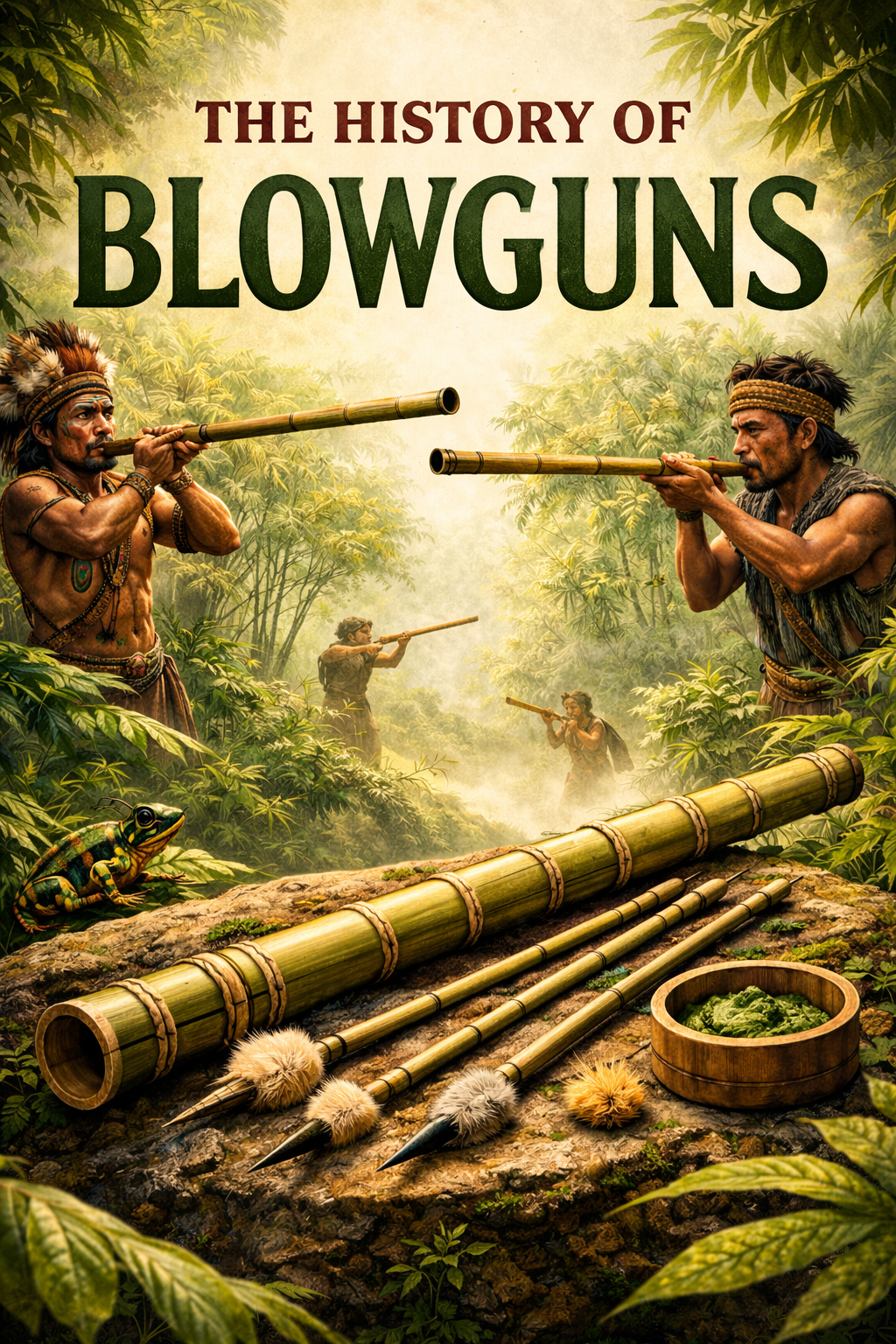
Blowguns are among the oldest projectile weapons known to humanity, yet they are often overlooked in discussions of historical arms. Simple in construction but demanding in skill, blowguns have been used for thousands of years across multiple continents. From dense rainforests to river valleys and mountainous regions, blowguns evolved independently in many cultures as effective tools for hunting and, in some cases, warfare.
The history of blowguns reveals much about human ingenuity and adaptation. Despite their modest appearance, these weapons demonstrate a deep understanding of physics, materials, and environmental conditions. Long before firearms or even bows became widespread, blowguns offered a quiet, precise means of delivering projectiles with remarkable accuracy.
Early Origins and Independent Development
Blowguns did not originate in a single place or culture. Archaeological and anthropological evidence suggests that they developed independently in several regions, including Southeast Asia, Central and South America, and parts of Africa. This independent invention reflects the simplicity and practicality of the concept: a hollow tube, a lightweight projectile, and human breath used as propulsion.
In many early societies, readily available materials such as bamboo, reeds, or hollowed wood made blowgun construction feasible. These natural materials allowed early craftsmen to create long, straight tubes capable of directing darts with surprising consistency. Over time, techniques for boring, smoothing, and sealing the interior of blowguns became more refined.
The widespread emergence of blowguns underscores their effectiveness in environments where stealth and precision were more valuable than brute force.
Blowguns in Southeast Asia
Some of the earliest and most sophisticated blowgun traditions emerged in Southeast Asia. Indigenous groups in regions that are now part of Indonesia, Malaysia, the Philippines, and Borneo developed blowguns that could exceed six feet in length. These long tubes allowed for greater air pressure and improved accuracy.
Southeast Asian blowguns were often paired with darts tipped with plant-based or animal-derived poisons. This combination made the weapon highly effective for hunting small to medium-sized game. Even a minor wound could prove fatal once poison entered the bloodstream, allowing hunters to track prey without the need for powerful impact.
Blowguns in this region were often treated as essential survival tools and were sometimes decorated or crafted with great care, reflecting their importance within the culture.
The Role of Blowguns in the Americas
Blowguns also played a significant role among indigenous cultures in Central and South America, particularly in rainforest regions such as the Amazon Basin. Tribes developed blowguns optimized for dense vegetation, where visibility was limited and stealth was crucial.
American blowguns were frequently used to hunt birds, monkeys, and other arboreal animals. The quiet operation of the weapon prevented startling nearby game, allowing hunters to make multiple kills in a single outing. Darts were often made from hardwood splinters or palm spines, fitted with cotton or plant fiber cones to create an airtight seal within the tube.
Poison use varied among cultures, but where applied, it dramatically increased the blowgun’s lethality.
African Blowgun Traditions
Although less widely known, blowguns were also used in certain regions of Africa. These were typically shorter and sometimes combined with thrown darts or other projectile tools. African blowgun designs reflected local materials and hunting needs, with an emphasis on portability and ease of use.
In some cases, blowguns were used by younger hunters or as training tools, helping develop breath control and aim. While they were not as dominant as bows or spears in many African cultures, their presence further illustrates the widespread appeal of silent projectile weapons.
These varied traditions highlight how blowguns were adapted to different environments and cultural priorities.
Construction and Materials
Traditional blowguns were crafted from materials readily available in the local environment. Bamboo was especially favored in Asia due to its natural hollowness and straight growth. In regions without bamboo, craftsmen hollowed wooden shafts or joined multiple pieces to form long tubes.
Interior smoothness was critical. Even slight imperfections could disrupt airflow and reduce accuracy. Craftsmen used natural abrasives, heated rods, or hand tools to smooth and align the bore. Some cultures even used animal fats or resins to seal and polish the interior surface.
The darts themselves were carefully balanced and lightweight, often featuring a soft cone or tuft to ensure a tight fit within the tube.
Skill, Training, and Technique
While blowguns appear simple, effective use requires significant skill. Hunters had to develop precise breath control, consistent posture, and strong lung capacity. Accuracy depended on maintaining a steady airflow and releasing the dart smoothly without disturbing the tube’s alignment.
Training often began at a young age, with children learning through practice and observation. Blowgun use was as much about patience and discipline as physical ability. Mastery of the weapon reflected a deep understanding of both technique and environment.
This reliance on skill rather than mechanical power distinguishes blowguns from many later weapons.
Blowguns in Warfare and Defense
Although primarily used for hunting, blowguns were occasionally employed in warfare or ambush scenarios. Their silent operation made them useful for surprise attacks, particularly in jungle environments where close-range engagements were common.
Poison-tipped darts could incapacitate or kill enemies without alerting others nearby. However, blowguns were generally limited to specific tactical situations rather than open combat. Their lack of stopping power and reliance on precision made them less suitable for large-scale warfare.
Even so, the psychological impact of an unseen attack should not be underestimated.
Decline With the Arrival of Firearms
The spread of firearms gradually reduced the practical use of blowguns in many regions. Guns offered greater range, stopping power, and versatility, especially for larger game or defensive needs. Over time, blowguns became less common as primary hunting tools.
However, in remote areas where firearms were scarce or restricted, blowguns remained in use well into the modern era. Their simplicity, low cost, and quiet operation ensured their continued relevance in specific contexts.
The decline of blowguns was gradual rather than sudden, shaped by access and necessity rather than outright obsolescence.
Cultural Preservation and Symbolism
In many indigenous cultures, blowguns remain important symbols of heritage and tradition. They are used in ceremonies, demonstrations, and educational settings to preserve ancestral knowledge. Crafting and using a blowgun connects practitioners to their cultural roots and the skills of their ancestors.
Museums and anthropological collections often feature blowguns as examples of early weapon technology and environmental adaptation. These displays highlight the ingenuity involved in their design and the cultural significance they carried.
Preservation efforts have helped ensure that blowgun traditions are not lost to history.
Modern Recreational Use
In modern times, blowguns have found a place in recreational and sport shooting. Contemporary blowguns are often made from aluminum or carbon fiber and are used for target practice rather than hunting. This modern adaptation emphasizes skill development and accuracy rather than survival.
Blowgun competitions and clubs exist in some regions, promoting safe and responsible use. While these modern versions differ from their traditional counterparts, they still require breath control, focus, and precision.
This revival reflects renewed interest in simple, skill-based tools.
Blowguns in Popular Culture
Blowguns have appeared in popular culture, often portrayed as exotic or mysterious weapons associated with jungle environments or stealthy characters. While these portrayals sometimes exaggerate their effectiveness, they have helped keep blowguns in the public imagination.
Popular culture has contributed to both fascination and misunderstanding, occasionally overlooking the skill and cultural knowledge required to use blowguns effectively. Nonetheless, this exposure has sparked curiosity about their real-world history.
For many, blowguns serve as an entry point into learning about indigenous technologies.
The Enduring Legacy of the Blowgun
The blowgun’s legacy lies in its elegance and efficiency. As one of humanity’s earliest projectile weapons, it demonstrates how simple principles can be harnessed to meet complex survival needs. Across continents and cultures, blowguns evolved to reflect local environments and traditions.
Though no longer a primary tool for survival in most societies, blowguns continue to be respected as symbols of ingenuity, patience, and skill. Their history reminds us that effective tools do not always rely on complexity or force, but on understanding materials, environment, and human capability.
From ancient forests to modern target ranges, the blowgun remains a testament to the quiet power of precision and the enduring creativity of human craftsmanship.
 Knife History
Leave a comment