
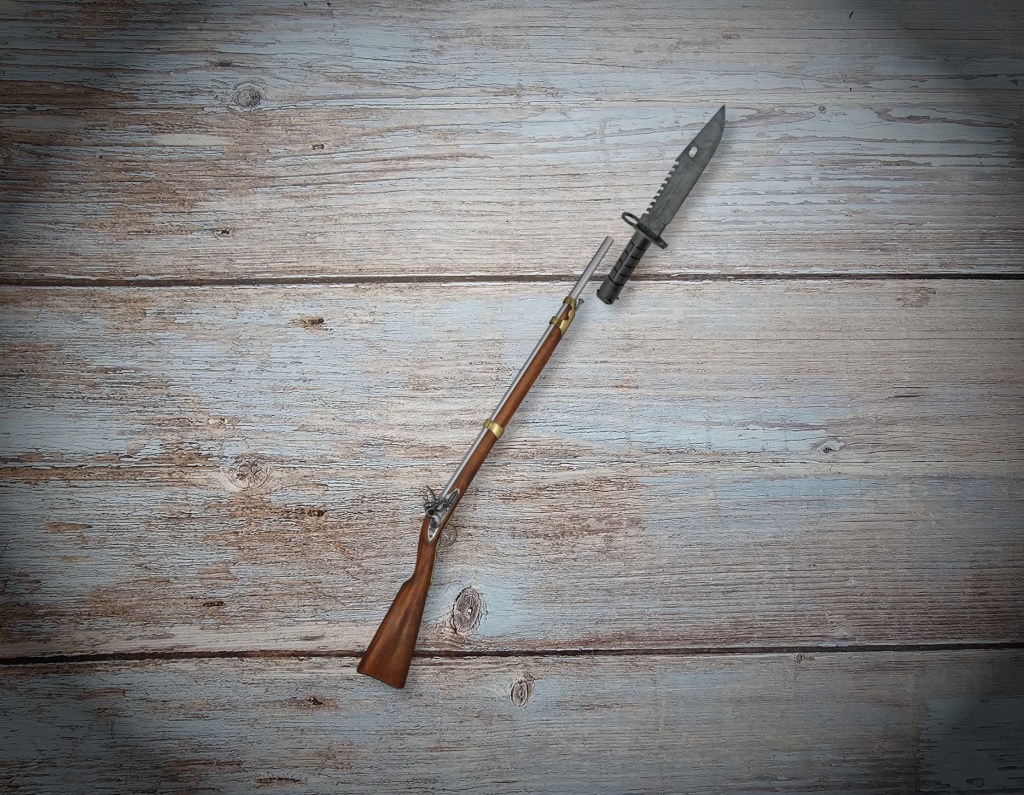
The History of Bayonets: From Pike to Modern Warfare
Bayonets, the iconic blades affixed to the muzzles of rifles, have played a crucial role in military history for centuries. Their evolution reflects broader changes in warfare, weaponry, and tactics. From their origins in 17th-century Europe to their diminished role in modern conflicts, bayonets have undergone numerous transformations, adapting to the changing needs of soldiers on the battlefield. This article explores the history of bayonets, tracing their development, tactical significance, and eventual decline.
The Origins of the Bayonet
The bayonet’s origins can be traced back to the early 17th century in France. The term itself is believed to derive from “Bayonne,” a city in southwestern France where early versions of the weapon were allegedly produced. The earliest bayonets, known as plug bayonets, were essentially dagger-like blades that could be inserted directly into the muzzle of a firearm. This innovation allowed soldiers to turn their muskets into spears when they ran out of ammunition or had no time to reload.
While plug bayonets provided a valuable melee option, they had a significant drawback: once inserted, the firearm could no longer be used for shooting. This limitation prompted the development of a more practical alternative—the socket bayonet—in the late 17th century.
The Rise of the Socket Bayonet
The socket bayonet, introduced in the late 1600s, revolutionized infantry combat. Unlike its predecessor, the socket bayonet attached to the outside of the musket barrel via a sleeve (or socket) mechanism, allowing the soldier to fire while keeping the blade fixed. The French army was among the first to adopt this improvement, and by the early 18th century, most European armies had followed suit.
This shift coincided with the decline of the pike in European warfare. A pike is a long spear, typically 10 to 20 feet in length. Historically, pikes had been used by infantry to counter cavalry charges, but with the introduction of the socket bayonet, musketeers could now serve both as shooters and spearmen. The bayonet thus contributed to the increasing dominance of musket-armed infantry in European battlefields.
Bayonets in the Napoleonic Wars
The Napoleonic Wars (1803–1815) marked a high point in the use of bayonets in large-scale battles. The French army, under Napoleon Bonaparte, emphasized aggressive infantry tactics, and bayonet charges were a key component of their battlefield doctrine. Although musket fire was effective, it was often inaccurate, and battles frequently ended in close combat. The psychological impact of a massed bayonet charge was immense, often forcing enemy troops to break ranks before actual hand-to-hand combat ensued.
However, while bayonet charges were dramatic, studies suggest that relatively few battlefield deaths were caused by bayonets. Most casualties still resulted from musket fire and artillery, but the fear and morale effects of bayonets ensured their continued prominence in military tactics.
The Evolution of Bayonets in the 19th Century
As firearms became more accurate and faster to reload, the role of the bayonet evolved. The sword bayonet, introduced in the mid-19th century, was a longer, saber-like blade that could be detached and used independently as a short sword. This design reflected a shift in military thinking, recognizing that soldiers needed a versatile weapon that could be used both on and off the rifle.
During the American Civil War (1861–1865) and other 19th-century conflicts, bayonets were still standard issue, but their battlefield effectiveness was increasingly questioned. Rifled muskets and breech-loading firearms allowed soldiers to engage at longer distances, reducing the need for close combat. Nevertheless, bayonet drills and charges remained an essential part of military training.
Bayonets in the World Wars
The early 20th century saw the continued presence of bayonets in military service, particularly during World War I (1914–1918). Trench warfare created brutal close-quarters combat scenarios, and bayonets were frequently used in hand-to-hand fighting. The spike bayonet, a simple, stabbing implement, became popular for its ease of manufacture and effectiveness in confined spaces.
During World War II (1939–1945), bayonets were still issued to soldiers, but their battlefield role had diminished. Firepower had increased dramatically with the widespread use of machine guns, automatic rifles, and grenades. Bayonet charges became rare, though they still occurred in certain battles, particularly in the Pacific Theater, where Japanese soldiers often launched fierce bayonet assaults.
The Bayonet’s Role in Modern Warfare
By the late 20th century, the bayonet had largely become a secondary weapon, more useful for utility purposes than for combat. Many modern bayonets are designed as multi-purpose tools, incorporating features like wire-cutting capabilities and serrated edges for fieldwork.
Despite its reduced battlefield role, the bayonet has not disappeared entirely. As recently as the Iraq War (2003–2011), there were documented instances of bayonet charges, though they were rare. Military training still includes bayonet drills, primarily for instilling aggression and discipline rather than preparing soldiers for frequent hand-to-hand combat.
The Enduring Legacy of the Bayonet
The bayonet has played a significant role in military history, evolving from a simple plug-in dagger to a sophisticated multi-use tool. While its importance in direct combat has declined, the bayonet remains a symbol of military tradition and discipline. Its history is a testament to the changing nature of warfare, reflecting broader shifts in weaponry, tactics, and battlefield strategy. Though no longer a decisive weapon, the bayonet’s legacy endures, reminding us of the brutal and often desperate nature of combat throughout history.
 Knife History